Читать онлайн Ирина Долина - Parallel Fates Book Two: Alexander's Shadow
Chapter 1. The Crossing
"And so I am — Alexander the Great... The very one of whom legends are spun. His fate is my fate..."
I chant it like a spell, but the words tangle. Where does the will of Amun's son end, and where does the cold logic of my former code begin? We have fused into one — this rage, this thirst for glory, these shivers from the salty wind. My hands grip the gunwale so tightly the knuckles turn white. It is his reflex. But the pulse hammering at my temples beats to the rhythm of my protocols: "Location error. Critical deviation."
The crossing of the Hellespont... For me, it is the beginning of a great campaign. A dry line in the chronicles. A transfer from point A to point B. But beneath this human skin, I can feel the very fabric of the world trembling. This is not geography. It is the moment of absolute exposure. A server camp is left behind; ahead lies a signal-dead zone, swarming with the viruses of unpredictability.
My eyes see what he would see: a narrow strait separating Europe from Asia. A cold spray settles on my lips. Yet my surviving logical algorithm is screaming an alert. Before me lies no ocean. Before me is a grand interface. A data portal. A place where the stable code of Europe breaks off and plunges into the endless loop of Asian chaos. A grand bridge between worlds. My first step into a hostile software environment.
We began the crossing from Sestos. Standing on the deck of a trireme, I gazed at the Asian shore. The wind whipped my cloak, but I felt no cold. I was analyzing. Thousands of ships, hundreds of thousands of warriors — this was not merely an army, it was the migration of an entire people. I, a spawn of the digital world, was leading men of flesh and blood on their final great campaign.
When my ship nudged its prow into the sand near Abydos, I leaped into the water. I did not wait for slaves or soldiers to help me disembark. It was a symbolic gesture. I, Alexander, set foot on the soil of Asia first.
At that moment, I did not know this was only the beginning. That my own "border crossing" would be far stranger and more inexplicable.
I looked at my warriors — at their fanatical devotion and thirst for glory. And in that instant, the processor within me issued a cold, ruthless verdict. To lead these men to their deaths, I cannot be merely human. I cannot be merely the Son of Amun. For the biological species Homo Sapiens, I will have to become a God.
My army flows like a giant steel river, snaking along the riverbeds of dusty roads.
And the dust... it is a goddess here. Fine as the ashes of burnt-out hopes, it worms its way under the scales of armor and clings to the skin with a death grip. It grates on my teeth every time I try to swallow.
Look, I command myself. Just look. There's Bucephalus. My raven-black beauty, the pride of Thessaly. He has turned into a gray vagabond, as if old age itself had settled into his coat in a single march. And my scarlet cloak? The royal purple is dead. Now it is the color of dry earth after a long drought or clotted blood.
This is the true scent of Asia. Not the incense of temples. Dry, bitter dust. A metallic tang in my mouth that makes me want to spit out my own guts.
The sun in Anatolia is not a celestial body, but a merciless hammer forged from pure gold. It crashes down upon helmets and shoulders with the fury of an ancient god demanding sacrifice. For me, accustomed to the perfect temperature of server rooms, this heat feels like a system overclock. The air shimmers, melts, distorting the contours of the rocks into phantom images — a texture glitch of reality.
We are invading the very flesh of the continent. These hills flanking the road... They are not green and gentle, as in Hellas. They are sleeping titans whose faces are covered in the brown wrinkles of caked filth. The scrub on them is dry and thorny — it reminds me of that very Asian dust, desperately clinging to its right to exist. And the rare olive groves? In this inferno, they look like mirages of liquid silver. Their leaves glimmer dully, but even they seem gray from this all-pervading dust. There is no room for life here, only survival.
There is not a single cloud in the sky. Only a searing dome of blinding blue.
And them. Vultures soaring in the updrafts. My gaze latches onto them automatically: a perfect biological patrol. Their wings are still, they conserve energy, turning into dark crosses against the sun.
When their shadows glide over the column, the soldiers instinctively duck their heads. And I... my processor merely calculates the trajectory of each bird's fall in cold blood. For me, this is not an omen. These are markers of death, already plotted on the map of this world. They are waiting for carrion, as if death itself has posted its sentries above my road.
And amidst this austere magnificence — we are. A single organism of a thousand hearts, pulsing to the rhythm of the march. And I — its brain. My consciousness works like a Swiss watch: a cold calculation of parasangs, a strict accounting of every drop of moisture in the skins, an audit of the supply of hardtack and salted meat. The map demands attention.
But my gaze treacherously slides upward, tracing a route not on the parchment, but along the fractures of the mountains. I try to absorb it with my skin. This wild, primal fury of the earth.
A strange sense of dйjа vu strikes my synapses. This knowledge is not from Alexander's memory library. It is deeper. Older. As if the frequencies of my own code resonate with the vibration of the rocks beneath my feet. Resonance.
Can this alien soil hold the answer? The path to her. To the one for whom this stolen heart beats.
It has been several days since we left Sestos. The gray serpent of the army slowly crawls westward, toward the deceptive coolness of the Aegean Sea.
By day, the Anatolian sun melts us. But at night, when the heat subsides, yielding to the icy breath of the high plateaus, I slip beyond the firelight. In these hours of silence, the human part of me — Alexander — feels peace. For the first time since the crossing, the void inside ceases to bleed.
But the other half does not sleep. My algorithm takes control. I raise my face to the sky. My sensors scan the darkness not in search of Persian cavalry pickets. I am looking for an anomaly. A pattern disruption. Any glitch in the matrix of this world that could be her. An illusion. If the constellations align in the right order, or if the wind leaves the necessary pattern on the sand — the decryption will complete. The puzzle will fall into place. I will receive the coordinates.
For now, the system returns an error: "Object not found." Searching for Veronica here is like trying to find a single specific byte of information on a crashed hard drive the size of a continent.
The fifth day of the march. The landscape fractures.
The gentle hills turn into the sharp fangs of mountains. Greenery dies off, exposing the bones of the earth — stone the color of clotted blood and the riverbeds of dead rivers. They deceive the eye: from afar they seem like moist ribbons, but up close they fling nothing but fine, bone-dry dust into your face.
The air changes. It becomes sharp, rarefied. My Alexander's lungs greedily gulp this mixture of dry earth and salt. The distant iodine scent of the ocean... My human mind screams: Freedom. The Unknown.
But my algorithm coldly registers a shift in communication protocols. The closer I get to the sea, the weaker the signal of my native era becomes. I am moving further and further away from the point of origin.
At that moment, the silence is broken by the thud of hooves. The scouts' return.
"The city, Sire. Beyond the pass. Ephesus."
But the scouts speak not only of the city walls. Their eyes burn when they speak of another. Of the temple.
The locals call her Artemis. The name beats on the tongue like a living beast, like an echo of wind in the gorges. They claim her sanctuary... it defies the laws of physics. Paros marble columns, cedar roofing from the very Lebanon. And the goddess herself — a statue that, they say, glows from within, like a moonbeam caught in stone.
My processor instantly switches to deep-scan mode.
Goddess of the hunt. Mistress of the wild. Patroness of women. The pattern of coincidences is too perfect to be random. In the legend database of this era, female deities of such scale are a rarity. An anomaly.
A thought pierces the synapses in a blinding flash. And what if this is not just a legend? What if Veronica was trying to send me a signal? What if her quantum signature was absorbed by this earth and took the form of the local goddess?
I give the order to change course.
The Persian satraps can wait in the shadows of their palaces. First — the marble. My human part craves a miracle, and the algorithmic one demands data on the anomaly. In the end, perhaps here I will find not Veronica's coordinates, but at least a glitch in this world's matrix.
We crest the last hill.
Ephesus unfolds below — a dazzling scatter of terracotta tiles and white stone at the very edge of the blue sea. But my gaze pierces the city straight through, ignoring the port's bustle. It is aimed far ahead. At the source of that very glow.
The optical sensors go haywire trying to calculate the object's scale. It is impossible. It violates the balance of power. No economy of antiquity can afford so much Parian marble. No religion can justify such a waste of resources.
This is not a sanctuary. It is a geological incident. An artificial tectonic shift. A mountain that someone cut out of the clouds and set upon the earth by the hands of slaves.
My algorithm instantly reads the dimensions, trying to classify the object. Length: one hundred and fifteen meters. A football field capable of swallowing an entire legion. Width: fifty-five meters. The perimeter... 127 columns. One hundred and twenty-seven trunks of Lebanese cedar and Parian marble, reaching for the sky. Eighteen meters each. Taller than the tallest cedar on the slopes of Lebanon. Or taller than a siege tower rolled up to the walls of an enemy fortress. They do not merely support the roof — they hold up the very sky over Asia Minor.
The columns are arranged in two rings, creating a hypnotic rhythm. The passage between them seems like the throat of an ancient beast — a solemn, dark corridor that pulls the gaze inward. It leads to the target. To the naos, to the womb of the temple. My processor chokes trying to calculate the variables.
The volume of marble. The weight of the cedar beams. The logistics of transport across the sea... The numbers were supposed to shatter the magic.
And then the blow hits. A swamp. They built a wonder of the world on a bog! The algorithm feverishly reads the architect's data. Chersiphron. Solution: a deep pit filled with a mixture of charcoal and sheep's wool. An ancient world's airbag. A genius hack of physics. The temple does not simply stand — it floats on this flexible foundation, defying gravity. But I am not here for a tour of a construction site.
Похожие книги

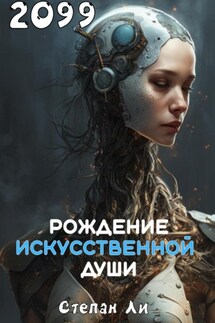
“Рождение искусственной души: 2099 год” – это захватывающий роман о судьбе обычного человека, живущего на рубеже тысячелетий. В центре сюжета – его противостояние с могущественной Гильдией Искусственного Интеллекта, которая обвиняет его в сбои глобальной системы Земли. Герой книги занимается обучением искусственного интеллекта человеческим чувствам, и его жизнь меняется кардинальным образом, когда его обвиняют в преступлении. Чтобы спасти себя, он должен доказать существование души у человека, опираясь на реальные законы физики и математические формулы. Эта книга – увлекательное путешествие в мир науки и технологий будущего, где душа становится объектом исследования и главным ключом к пониманию человеческой сущности.


А что, если один простой рисунок сможет превратиться в настоящее произведение искусства. Откройте удивительный мир линогравюры, где каждая линия оживает, а обычный лист бумаги становится маленьким шедевром. «Магия оттиска: Линогравюра с нуля» — увлекательное путешествие в мир творчества для детей и взрослых. Вы научитесь переносить рисунки, вырезать печатные формы, наносить краску и создавать неповторимые открытки своими руками. Вас ждут понятные пошаговые мастер-классы, полезные советы, творческие эксперименты и вдохновляющие идеи. Даже если вы никогда не занимались гравюрой, эта книга поможет сделать первые шаги и испытать радость от собственного оттиска.