Читать онлайн Konstantin Schilin - Oilfield Services (part one)
INTRODUCTION
The main idea behind writing this book is the desire to share my many years of experience working in oilfield service organizations, acquired over a forty-year period of work in various countries and the political systems existing in them, and to analyze, together with the reader, various approaches to the implementation of technological processes in oilfield services.
During my career, I had the unique opportunity to work both in a "developed socialist" country and in several Western countries with a well-developed and well-structured oilfield services infrastructure. I observed and actively participated in the transitional process of economic restructuring in the former Eastern European countries and the Soviet Union; witnessed the success and failure of the largest acquisitions in the history of the oilfield services industry; and met and befriended remarkable people—true professionals in their field. It was precisely these interactions with them that allowed me to subsequently select the most effective approaches to organizing production processes and apply them in my own work.
People often ask rhetorically: "If I had the chance to start over again at the beginning of my professional life, would I take the same path?" Without a doubt, I would say YES! This doesn't mean I've always succeeded or haven't experienced disappointments and, at times, deep downfalls. I've had to endure much—the joy of dizzying success, the realization of the worthlessness and, at times, the stupidity of some of the people who made decisions about my career advancement, the betrayal of my team members and friends. But this is the essence of me, the essence of who I have become and am today. I am grateful to them all: to those who raised me up and to those who pushed me down—they all helped shape me into who I am today!
I had the opportunity to actively witness and even participate in two of the largest acquisitions/mergers in the history of the oilfield services industry, both of which ended in utter failure and financial disaster. A parallel can be drawn from the lives of politicians: most of those who, through their non-professional activities, caused significant damage to the state, typically moved on to other jobs and were subsequently promoted. These examples are readily available, so I won't cite them.
I am deeply grateful to those who, despite the enormous risks to their own careers, believed in me and gave me the opportunity to demonstrate my potential and abilities. One of them once told me frankly, "Don't delude yourself about your significance and uniqueness—I'm doing this not for you, but for myself—because your success will ensure my success on a much greater scale!" This man became my mentor for many years and will occupy a special place in the description of several events recounted in this book.
The book is structured into four Time Stages, each of which relates to a specific era of development of both political change in society and technological processes in the oilfield services industry:
THE FIRST STAGE refers to the Soviet era and covers the time interval from 1982 to 1989.
THE SECOND STAGE is the years I spent at SCHLUMBERGER; the time interval from 1991 to 2004.
STAGE THREE – the time and highlights of my production activities at HALLIBURTON; the period from 2004 to 2017.
STAGE FOUR – refers to the time of my development and implementation of the Strategy for the Development of the National Oilfield Services Business in Russia and Kuwait in the period from 2017 to 2019.
SO HERE WE BEGIN.
1.MAIN STAGES
1.1.THE SOVIET ERA (from 1982 to 1989)
Seven years of experience working at the Central Geophysical Expedition (CGE) of the USSR Ministry of Oil Industry. I certainly appreciate the enormous help and support provided to me by my first teachers and mentors: Serker Akberovich Serkerov (Department of Field Geophysics, Gubkin Moscow Institute of Oil and Gas), Viktor Iospa, Alexey Stepanchikov, Alexander Averbukh, and Georgy Gogonenkov (CGE).
Some of the most memorable events in my career during this period include:
1. Development of a methodology for the joint use of gravity/magnetic exploration data and seismic exploration data in the integrated interpretation of geological and geophysical information; I developed and implemented a software package for the stable solution of inverse problems of geophysics based on the regularization method approach (SIDSiG – a software package for solving problems of Joint Interpretation of Seismic and Gravity Exploration Data). Registration number in the State Fund of Algorithms and Programs of the USSR – 50880000156. This software package was implemented for commercial use in several geophysical organizations of the USSR Ministry of Oil Industry for solving problems of prospecting and exploration of minerals in the Volga-Ural oil and gas province and the Caspian Basin.
2. In collaboration with Dmitry Krylov (CGE), a technology for obtaining a stable solution to the inverse problem of seismic exploration was developed and implemented into production. This technology is based on the selection of a wide range of regularization functionals (cases of one- and two-dimensional models of the medium). Based on the results of joint research and experiments, the book "OPTIMIZATION METHODS OF INTERPRETATION OF COMPLEX GEOPHYSICAL INFORMATION" (ISBN 9785853580992 / 5-85358-099-X) was published by SCIENCE Publishing House in 1991.
1.2. INTERNATIONAL COMPANIES
1.2.1. SCHLUMBERGER (1991 – 2004)
During my time at SCHLUMBERGER, I held various positions in Germany, Canada, Russia, Ukraine, Belarus, the Baltic states, Azerbaijan, Uzbekistan, and Kazakhstan. I had the wonderful opportunity to meet, work with, and learn from such outstanding people as Albrecht Glocke, Mayer Bengio, Jorgen Rasmussen, Dan Daily, and many others
The most significant events during this period include the following:
1) Participation in the largest 3D seismic survey project for EXXON in the Canadian Arctic (where I worked as Deputy Head of the Seismic Crew).
2) Signing of the first commercial contracts and commencement of operational activities of the SCHLUMBERGER Company in Ukraine, Belarus and the Baltic States; Opening of the first SCHLUMBERGER OFS production offices in Kyiv (Ukraine) and Gomel (Belarus).
3) Participation in the Production Process Management and Optimization Project at YUKOS Oil Company (Russia's largest oil company from 1993 to 2003). Together with Olivier Favre and Vladimir Pivovarov, a collaboration between SCHLUMBERGER OFS and YUKOS Oil Company was initiated. This unique project enabled SCHLUMBERGER to significantly expand its production and research activities in Russia and establish itself as the number one oilfield services provider with its own research and development center in Moscow.
4) Together with Günther Schmidt and Dominique Fache (Schlumberger Industrias), a cooperation process was initiated between SCHLUMBERGER and the National Joint Stock Company Naftogaz of Ukraine (the structure of the oil and gas industry of Ukraine, created by the order of President L.D. Kuchma in 1997). With the start of this project, SCHLUMBERGER received the opportunity to enter the oilfield services market for both national and international oil and gas operators in Ukraine.
5) The first Projects of the SCHLUMBERGER Company with the Joint Venture TNK-BP (BP and Tyumen Oil Company) were signed by the Schlumberger Information Solution division, where I headed the Sales Department at that time.
6) Business growth with the largest Oil Operators of Western Siberia – OJSC SurgutNEFTEGAS and Oil Company LUKOIL.
7) Participation in the creation of the Territorial Bank of Natural Resources of the Yamalo-Nenets Autonomous District.
8) Participation in the formation and liquidation of the First Team of SCHLUMBERGER – SEMA.
1.2.2. HALLIBURTON (2004 -2017)
Having joined Landmark Graphics Corporation (a Halliburton Software Company) in 2004, I held several positions across the Eurasian region: Russia, Ukraine, Belarus, Kazakhstan, Uzbekistan, Turkmenistan, and Azerbaijan. I concluded my career at HALLIBURTON as Vice President for Russia and Sakhalin in 2017. The success of my fruitful career is undoubtedly linked to the names of my mentors, managers, and friends, such as Joe Rainy, Mike Hugentobler, Scott Cooper, Dean Radojevic, Dmitry Chasovskikh, Orest Kasparov, Amir Azizov, and many others.
Some of the key memorable moments during this period include:
1) In the position of Chairman of the Board of Directors of the joint venture PETRODATA Kazakhstan (Landmark and the Kazakh Institute of Oil and Gas), for the first time in the history of the joint venture, I brought its activities to a profitable level.
2) The Development Strategy of HALLIBURTON in Russia for the period from 2012 to 2017 was developed and implemented, including: both organic and inorganic growth – localization of production and strategic alliances with Russian oilfield service companies and drilling contractors.
3) Fivefold increase in the company’s turnover on Sakhalin (projects with Exxon NefteGas Limited and SEIC (Sakhalin Energy).
4) Increase in Halliburton’s turnover in continental Russia by 30%.
5) Reduction of the cost component of operating activities by 25%.
6) Implementation of an integrated approach for the most effective operation of HALLIBURTON service divisions in Russia (Integrated Project Management). Projects with Lukoil-Western Siberia, Lukoil-Komi, TNK-BP, Rosneft, ExxonMobil.
7) Implementation of the first project in Russia built on the principle of risk sharing with the Customer (TNK-BP, Nyagan – Em-Yoga Field).
8) Successful implementation of the project for joint production of Halliburton equipment with a Russian manufacturer (Nizhne-Kama Mechanical Plant).
9) Creation of a cohesive team of heads of Service departments and Directors of the business support functionality of the HALLIBURTON RUSSIA division.
10) Until 2014, I managed the HALLIBURTON division for the Region – Russian Federation, Ukraine and Belarus.
11) Participation in the process of the attempted takeover of BAKER-HUGHES by HALLIBURTON in the period from 2014 to 2016.
1.3. PRIVATE OILFIELD SERVICE COMPANIES IN RUSSIA – RIMERA GROUP (2017–2018)
In March 2017, I retired from HALLIBURTON and immediately received an offer from the Russian oilfield services company RIMERA Group (www.rimera.com). At that time, the shareholders of RIMERA Group had decided to transform the Company into the largest oilfield services company in Russia, compliant with advanced technologies and business standards in accordance with the Code of Quality, Occupational Health, Safety, and Environmental Protection.
As Vice President of HALLIBURTON, I was desperately short on time to analyze the detailed production processes required for my daily work. So, I eagerly immersed myself in the new role. I still have fond memories of my former colleagues – Svetlana Tudiyarova, Yegor Kropotin, and Igor Melnikov.
Over the 16 months of project implementation, the following results were presented to RIMERA shareholders:
Похожие книги

The second part of an autobiographical epic about the authors many years of experience in oilfield service organizations, acquired over a forty-year period of work in various countries and the political systems existing in them. This section outlines the key events that occurred during the author's tenure at LANDMARK EURASIA (Halliburton) from February 2004 to September 2011. The author not only shares his understanding of the key developments in the formation and evolution of leading oil and gas companies in Russia and the Caspian region, but also the key elements of the restructuring of key oilfield service operators' approaches during this period.


У каждого из нас есть бесполезные и даже вредные мысли и установки, которые усложняют жизнь и мешают достижению поставленных целей. Некоторые из этих «тараканов в голове» имеют вполне конкретные имена – например, синдром самозванца или тотальный контроль, – и знакомы очень многим. Чтобы избавиться от страхов и стеснения, решить проблемы из прошлого, обрести правильную самомотивацию, не обязательно прибегать к услугам психологов и коучей: приручить своих тараканов можно и самостоятельно – при помощи этой книги. Каждая ее глава – четкое руководство к действию, дополненное советами и подсказками, которые будут полезны в самых разных жизненных ситуациях.

Эта книга для вас, если:– вы не удовлетворены текущей ситуацией и хотите что-то изменить;– вы довольны жизнью в целом, но понимаете, что всегда можно больше и лучше;– у вас все прекрасно, но чего-то все равно не хватает, а вы не можете понять, чего именно;– вы взрослый ответственный человек и осознаете, что в ваших проблемах никто не виноват, а все изменения начинаются с вас;– вы готовы менять свою жизнь к лучшему, готовы действовать, а не ограничиваться сидением на трибуне, освистыванием игроков на поле и высокомерными фразами «я бы на его месте сделал иначе». Рекомендую вам читать книгу с блокнотом и ручкой.

Вы привыкли, что «хороший человек» не злится. Что злость — токсин, который нужно задышать или заменить сочувствием. Вы улыбаетесь, когда вас обходят с повышением, терпите хамство, ночью не спите, переваривая комок в груди. Спокойствие любой ценой — не добродетель, а медленное самоубийство. Эта книга — дерзкая альтернатива. Злость — суперсила, которую вы разучились подключать. Вы узнаете, как отличить конструктивный гнев, использовать адреналин и освоите протоколы: «Зелёный свет» (действие), «Воздушный шар» (сброс кортизола), «Рентген» (потребность). Плюс сценарии для переговоров, прибавки и защиты. Перестав гасить злость, вы не станете злым.
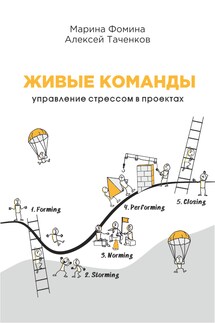
Эта книга из тех, прочитав которую, начинаешь жалеть, что у тебя ее не было раньше. В ней показано, какой огромный инструментарий доступен современному руководителю и как его применять на практике. В «Живых командах» системно и неожиданно соединились проектный менеджмент, управленческая психология и биология поведения человека. Системные модели в книге успешно сочетаются с практикой использования инструментов управления, а результаты современных исследований – с яркими историями людей, которые ежедневно решают сложные задачи бизнеса на фоне высокой стрессовой нагрузки. От первой до последней страницы книга насыщена полезным контентом.


Говорят, любовь не терпит условий. Они решили проверить это, превратив чувства в жестокую игру. Варвара собиралась исчезнуть из серого города навсегда, оставив позади выцветшие обои и старую боль. Но Глеб сделал ставку на её слабость к сильным мужчинам, заперев её в лабиринте дерзких провокаций. А Тимур предложил ставку на потребность в тепле, обещая исцелить ожоги одним прикосновением. Для них это спор, где цена поражения — собственный дом. Для нее — пытка выбором между пожаром и спасительным пледом. Когда последний автобус увозит фальшивые надежды, а первый снег заметает пути к отступлению, им придется признать: настоящая любовь начинается там, где заканчиваются любые правила и соглашения.